A conversation with writer, producer, and performer, Alison Flierl.
After spending her formative years sporting incredibly awkward chin gear, Alison Flierl now has an inarguably wonderful smile. As a successful comedy writer, her years of standing out have made her a pretty kick-ass comedian… with only 1700 trips to the dentist in her rearview mirror.
Born in New York and raised in Connecticut, Alison Flierl is a writer, producer, and performer now living in Los Angeles, CA. She’s written on a number of comedies ranging from late night, multicam, animation, and single-camera comedies, including Joey, Conan, BoJack Horseman, TV Guide Letter Theater, School of Rock, and many projects in development.
I had the pleasure of sitting down with Alison at one of the many Starbucks in Los Angeles, and we discussed all things career, writing, and – of course — BoJack Horseman. BoJack is one of my favorite shows, so I was pumped to ask her about working in that room, breaking story for an episodic show, and collaborating with animators on jokes!
Keep scrolling for more, and perhaps you’ll find some words of wisdom from someone who successfully made the jump from assistant to writer and beyond!
Starting Out:
PR: What was your first job in the industry after college?
AF: I did an internship during college, but my first real gig was working for a talent manager [in Los Angeles] as an assistant. Before that, I worked for a week as a producer’s assistant. She fired me on the day she gave birth, so that was an interesting introduction to Hollywood.
PR: I’m not sure how much time passed from then until you got your first staffing job, but can you talk about how you got that first writing gig on JOEY?
AF: I was the Writers’ Assistant there. That was my first Writers’ Assistant gig where I was in a room and got to see how things were made, so that [first script] came from being a Writers’ Assistant.
Then I worked as a Script Coordinator on a couple of shows, kind of moving up those ranks, and then I worked on some random things on my own. After that, I worked at Conan, and there I met Scott Chernoff, who I wrote with for many years. When The Tonight Show with Conan O’Brien got cancelled, we made a little web series for $100 called TV Guide Letter Theater about people’s letters to TV Guide.
It was something we made for nothing, and it got featured in TV Guide instead of them suing us, which was nice. We got invited to some TV Guide Hot List parties. It got featured on Funny or Die back then. It was something short that showed – hey, we can be funny! They were all one-minute episodes. We literally paid actors in pizza.
From there, we worked on Conan’s new show, I was writing pilots, and, eventually, I got the opportunity to write a couple of episodes of BoJack Horseman. One of my writing mentors said, “Always be prepared for every opportunity.” Luckily, we had an original pilot with a similar tone, and also a spec of Bob’s Burgers. So the more you write, you know…
Writing on BOJACK HORSEMAN:
PR: Were you in the room for BoJack Horseman, or was that when you were writing freelance episodes?
AF: I was the Script Coordinator, and then they gave me the opportunity to write two episodes.
PR: When you’re in the room for an animated, mostly episodic show like that, what does the process of breaking the season look like? Do you guys use note cards?
AF: Yeah, they used note cards and a whiteboard. Raphael Bob-Waksberg, the creator, usually had a general idea of what he wanted the season to be and some of the arcs. So the room would break everything down — figuring out what’s going to happen in each episode. There would be discussions, and people might pitch new ideas, but he would still plug it all into his general concept. He usually had a pretty fleshed-out vision in his head, but was also open to new ideas.
Once [the story of each episode] had been approved by Raphael, you’d go off and write an outline. You’d have a week to write the outline, bring it back, get notes, and then go off to script. You’d have about a week to write the first draft, get some more notes, make a few changes, and then make more changes based on the table read. Then they went pretty quickly into recording drafts and getting the actors in to record.
PR: How long would that take?
AF: A week for the outline, a week for the first draft, and then maybe three or four days after that to turn in the revised writer’s draft. Then a table read. I feel like it was maybe three weeks total per episode, but I’m not sure — it’s been a while.
PR: Was there a lot of collaboration with the animators on that project?
AF: Yeah! Lisa Hanawalt, who designed the look of it (and also wrote some other shows — she created Tuca and Bertie), was in the same building as the writers. She would show us drawings and was coming up with stuff too. There were also visual jokes that the animators added. For my episode, we had written in that there was an octopus in the control room… but I think there’s also an orangutan going by, holding onto the ceiling. That wasn’t written in — an animator thought of that and I thought it was hilarious.
Getting staffed on SCHOOL OF ROCK:
PR: When you wrote on School of Rock, did you have a children’s sample for that job, or did they go off a different sample?
AF: We had an original pilot about becoming a dad… it was called Man-Child. We just had a general meeting at Nickelodeon — they liked us — and then a few months later brought us in. It was one of those things where you’re just planting seeds everywhere and meeting people. Luckily, the showrunners liked us too. We had a meeting with them, and some of them knew my previous bosses from when I’d been an assistant. So even a job from fifteen years ago helped.
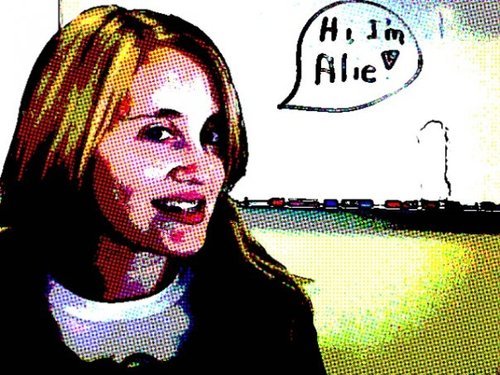
Alison Flierl, from https://alisonflierl.com.
 Payton Russell
Leave a comment