A conversation with screenwriter Alex Convery.
At Austin Film Festival, with so many writers thrust into a few small blocks of Austin’s already tight downtown, you can run into the greats almost anywhere. At Hideout Coffee House, as I was waiting in line for my fourth coffee of the day between panels, that’s exactly what happened.
Alex Convery, the writer of the hit Nike Michael Jordan movie, AIR, which topped the 2021 Black List under the name AIR JORDAN, is a nice, upbeat guy from Western Springs, Illinois. Speaking with Alex, it’s clear he is a true lover of the craft of screenwriting, and he works on his art each and every day.
Alex studied screenwriting at USC’s School of Cinematic Arts, and after graduation, he worked as an assistant for a couple years before leaving the entertainment industry altogether. In that time away, Alex became a traveling salesman and finally found the space to write again.
Below, Alex talks about his decision to leave the industry and also shares insights on crafting deep characters with inherent rootability and challenging conflicts. His advice is helpful and inspiring, and his passion for great storytelling is contagious. Keep reading for more!
—
Advice from Film School:
PR: What was a helpful piece of advice that you learned in film school at USC? Something that has stuck with you throughout your writing career so far?
Alex Convery (AC): A good writer is a good reader. Just like a good painter studies and goes to museums… you have to live and breathe it. In film school, we read scripts, but we were mostly watching movies. Which is great, but that’s not screenwriting, you know? They always say: You make a movie three times, and I found that to be very true. You can’t learn how to sell a spec script from watching a movie. It can help you, but you really need to learn what a manager is interested in reading, or what an executive is interested in reading. I loved film school, but at the same time I was 18, 19, 20 years old, it’s, like: What the hell are you going to write about? You kind of have these grand ambitions, but you’re so limited by your ability and just lived experience. We all wrote the same bad 500 DAYS OF SUMMER, bad JOHN HUGHES movie, because what else did we know? I’m not saying you have to be a certain thing to write a certain thing, but I do think you need to live, and you need to have some experience out in the world. You need to take your nicks and bruises and get your heart broken and the whole deal. It’s just: that’s part of the writing life. So, yeah, film school was great, but I feel like it’s just as important to be doing those internships and being an assistant, as hard as it was.
Early Jobs:
PR: What was one of your biggest failures as an assistant?
AC: You know, worst of all, I wasn’t getting any writing done, which was very hard. It made a soul-sucking job even more soul-sucking. So, after two years, I was still using my writing sample from college; I was like, “I need to move on. I feel like I’ve grown, but my writing hasn’t.” So I kind of quit the industry, and I got a sales job. I was working for an online tutoring company as a salesperson, traveling the country, coming to Austin and going to [The University of Texas] and trying to sell them online tutoring. Like a total Willy Loman [from DEATH OF A SALESMAN], traveling door-to-door salesman… In that time, I had a lot of crises of faith and sort of, “Man, why am I not in LA and not still in the industry?” But it really did allow me to write: It was a nine-to-five thing. I was traveling a lot, which isn’t always great, but for me at that time, I was able to lock myself in hotel rooms and get work done. And over those two years, I wrote the spec that got me repped, BAG MAN, which got me to Grandview and then to UTA shortly after. Faisal Khanan is still my manager.
Knowing When to Leave:
PR: What advice would you give current assistants and support staff for holding on and continuing to write through the long hours of their jobs?
AC: Persistence is everything. I mean, look, if you’re an assistant and you want to write, I would say you just have to know when you do your best work. For me, I had to leave being an assistant. I had to. Because I just didn’t have the time to write. What I would say, though, is I left feeling confident that I had built a quote-unquote “network”. I had been an intern for five years, I had all my film school friends, and I had two years worth of being an assistant. So I was like: if I write a great script, I have places to go with it. I have people I’ll send it to. You know, a year after that, I was starting to sweat. Like: “Man, these people must be so tired of hearing from me, the wannabe writer who used to be an assistant but failed out.” Look, it worked out! And I do think great writing always gets found, no matter where it’s coming from. You also have to find your mentors. That’s the most valuable thing. Pick their brains for everything… But persistence, you know, you just keep going. It’s hard, but you do get through it. No assistantship is forever. If it is, that’s a problem, honestly.
Research:
PR: I’m curious, when you’re working on a true story and doing all the research, how do you decide what’s going to stick and what is extra fluff you don’t need?
AC: It’s all about the character. Anything that is not directly impacting your protagonist and/or the dramatic tension around them, you don’t need it. You know, as a serial procrastinator, I think research is actually one of the most dangerous excuses around. Because, again, take AIR. I could have spent forever researching for that: What’s going on in 1984? Let me read about the election that year. Let me read about the Olympics. Let me read the entire history of Nike. Let me read Phil Knight’s autobiography. Let me read everything on Sonny… To me, the most important thing is to understand your character’s journey and understand the emotional truths of all the characters. What do the characters want? But after that, the research will always be there. So, I return to the research when I need it, you know? I get to a scene and it’s like, wait a sec… What was going on in July of 1984? Let me look into that. Wait, how much was Nike stock? What were their margins at that time? You can just go look that up anytime. And again, you’re making a movie, not a documentary. So, I do think you can’t be afraid to condense things or combine characters. And look, I think part of it is: what story are you telling? There are ethical responsibilities, of course, but, at the end of the day, I felt good about AIR because it wasn’t life and death, literally, you know. So, I felt a little more liberty to condense the shoe deal and make something happen in Chicago instead of Portland. If I was writing, I don’t know, SCHINDLER’S LIST, I’d have to be more careful, right? That’s talking about real people, victims, lives, horrible, horrible, dark things. And you’ve got to get that right. So, it probably just depends on what the subject is.
Wants vs. Needs:
PR: For AIR, when you’re talking about the character’s want, how do you make that something small and tangible? I feel like a lot of times I get caught up in the life goals: They want to feel less lonely. But that’s not a want, right?
AC: No, that’s a need, that’s not a want. You need to find a proxy, a visceral thing that represents that. The best movies, to me, are when they get what they want but realize it’s not what they need. That is what you’re talking about. For me, in AIR, in the script, Sonny’s want was to sign Michael Jordan. But, his need was to go for a run, you know, just getting out the door and running a block. To me, that represented the stagnation he was feeling in his life. So, that’s what I was working toward: He got Michael Jordan, but what it really led to was — and that was the final scene of the spec — was him opening his door, overweight, in his sweatpants and just starting to run, you know? Even though it seemed crazy, it’s what he needed.
PR: What do you do if a want changes throughout the film or the pilot or episode?
AC: There are great mid-point reversals. These things are very hard, but I think when you look at the best movies: less is always more. I think you can always be more simple than you need. And I think the other thing is: don’t over-explain. The audience will always catch up to you; you don’t need to follow behind them and tell them, “Go this way, go that way.” You want them catching up to you, right? One of my favorite screenwriting quotes is from Billy Wilder: “You tell the audience two plus two. Let them figure out that’s four.” Bad screenwriting is four, four, four, four, four, right? I’m also big on character intros. What action can you introduce the character with that tells us exactly who these people are? There are so many good examples. THE DEVIL WEARS PRADA is one I always talk about. It’s so good because it’s just two women getting ready for the day, but you know right away who these people are. You understand without any dialogue who Anne Hathaway is and who Emily Blunt is. And you’re like, “Oh my God, if these people ever get in the same room, there’s going to be trouble.” What happens five minutes into the movie? GRAND BUDAPEST HOTEL is so good; like with Ralph Fiennes’ introduction, he’s walking through the hotel saying, “That goes there, that goes there. Did you check this?” This is a man who is a master of his domain. He goes by a code, and this hotel is his love. But you know deep down, that love is going to be tested. That, to me, is just so fascinating… I also think Pixar is always the best to study. They write the movie basically ten times, over and over and over again, so this stuff is just so dialed in. To me, Pixar does the best first acts. You have such a complete understanding of the world, even though it’s about toys or bugs or monsters. The great thing in Pixar is that the character is always asked to confront their biggest fear by the end of Act One. Like, Woody gets replaced. Marlin loses Nemo. Mike and Sully let a kid in. It’s so masterful that fifteen minutes into the movie, the worst possible things happen to them, and I feel scared for them… I get emotional just talking about it because they’re such complete characters… There’s not one way to write a screenplay. There’s not one format you have to follow. I do think you need some sort of universal character emotion that the audience is going to key into, but that all just comes from strong writing, you know? Putting your character in strong points of conflict and points of crisis.
Up Next:
PR: Are you working on anything right now?
AC: I’m doing another movie with Skydance, and I’m also working on a rewrite right now… Hopefully I’ll be able to talk about both of those things early next year. And then, my big lesson from here is: I’m always spec-ing. Always, always, always. I’m doing a journalism movie right now, which I’m excited about. It’s a genre I love: It’s tried and true. It’s been hard, and it kind of scares me, but I think that’s good.
Thank you, Alex, for your time and energy in chatting at the festival! And thanks to AFF for providing a fun space for
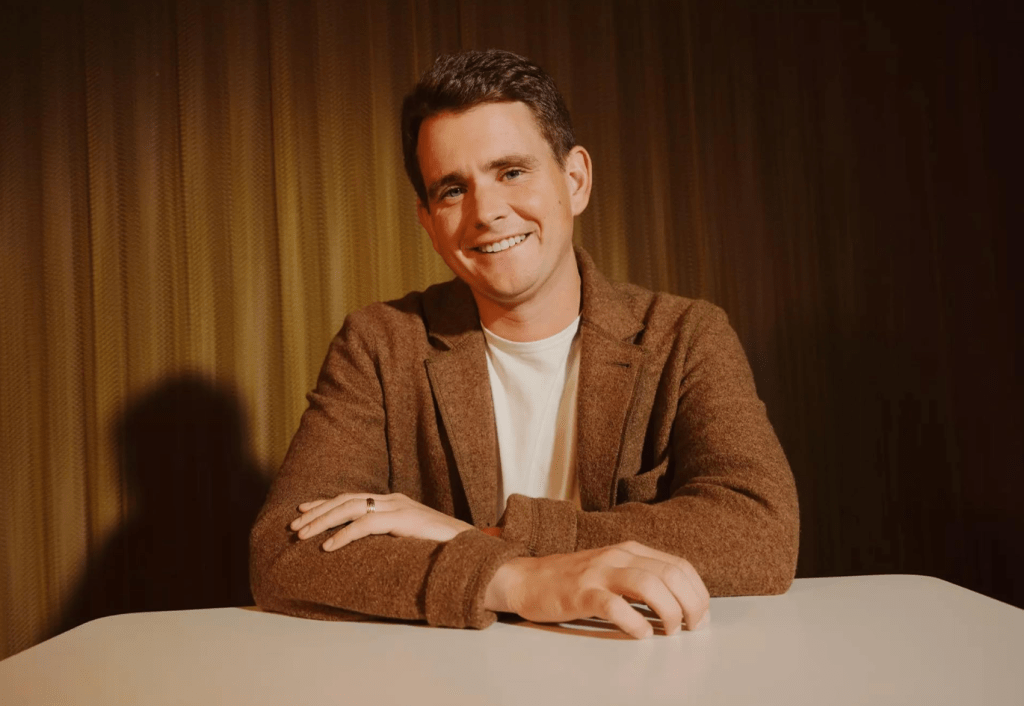
Alex Convery. Photo copyright is owned by Julien James / For The Times.
 Payton Russell
Leave a comment