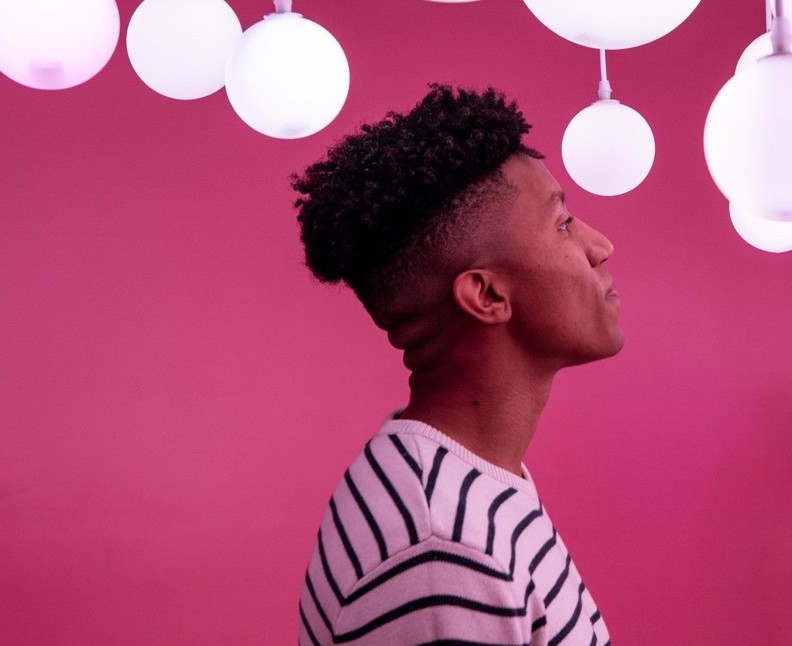
A conversation with writer, director, music manager, and athlete, Chaz Hawkins.
As a writer with big ambitions to succeed as an athlete, have a long, loving relationship, maybe a dog or two, and travel the world, I sometimes find it hard to find myself in the brooding, sedentary, sequestered stereotype often attributed to other writers (Look up “writer” and the images are literally all men sitting alone in the dark).
However, at the Austin Film Festival, sitting across from Chaz Hawkins, a writer, athlete, director and music manager (with amazing fashion taste) from Tennessee, the fullness of a working writer’s life became much more clear, and the potential for individuality within this career was really exciting to me.
Chaz moved to Los Angeles in 2017, and in 2020, his psychological thriller feature, THE SAUCE, landed on the Blacklist. Not long after, Chaz was in the writer’s room on HBO’s WHO FEARS DEATH, and then he wrote for two seasons on Amazon’s Emmy Award-winning series, FALLOUT. Chaz is a gamer and takes pride in his Nashville roots.
Through this conversation with Chaz, we discussed balancing multiple projects, the importance of each meeting, and creating your own opportunities to be creative. Keep scrolling for more details on how he got his start as a staff writer in Los Angeles, and the musical artist he manages now!
—
Getting Started in LA:
PR: Can you talk about your move in undergrad from Duke University (Go Blue Devils!) out to LA? What made you decide to move to LA?
Chaz Hawkins (CH): Sure, so moving out to LA for me was mostly on a whim. I had a professor my junior year, prepping for my senior year, basically sit me down and say that public policy – which is what I majored in and decided to spend all my time in school working on – wasn’t working out for me and that I needed to switch and pivot and find something else that utilizes the same skills and also gives me the same utility out of the experience, but is a different form… I’m thankful for that professor because he then bought me a screenwriting book, Save the Cat, and I read that as well as a litany of other books shortly thereafter and fell in love with screenwriting as a late-stage senior at Duke. [I moved to LA because] basically it was like; there’s only two places this stuff gets done and New York doesn’t really feel like the type of writing I want to be involved in, truthfully, so I went to LA… I also was running track and field at the time, so I started training with a semi-professional coach while we were out here too, so it made the transition a little easier knowing that I had some element of familiarity out here.
PR: Before your professor gave that book to you, did you have any inkling that you wanted to be a writer?
CH: I mean, looking back, all of the pieces made sense, but I wasn’t assembling them that way.
PR: What were some of the pieces?
CH: I was a big journaler… I also wrote poetry and music, in particular, songs for a rock band as a kid. One of my first experiences receiving notes was actually from my dad. My dad watched the same [five] movies our entire childhood… and in particular, Baz Luhrmann’s ROMEO AND JULIET. My dad used to watch this particular emotional scene between Leonardo DiCaprio’s character and this other character, Mercutio. And I really liked Mercutio, and I felt he was done dirty by the writing of that scene. And I went upstairs, pulled out a piece of paper, and I wrote how I would have done that story in what I thought was a screenplay as an 11-year-old… I went down to my dad and was just like, “Boom, what do you think of this? This is so much better than that.” And my dad wasn’t much of a talkative guy, and so he read it, and he just looked at it, and he goes, “Hmm.” Then [my dad] strikes out a couple pieces, and then just gives it back.
And that was my first familiarity of experience doing and receiving notes from someone. And so I’d been having these experiences telling stories, whether it was at the campfire, bonfires with friends, or just being able to act in plays in school, that I had [thought were] just passive interests. [I thought]: I’m doing athletics. That’s my focus. That was always in my front-facing view. Everything else was kind of on the side. And once I kind of put this piece, [athletics], down, [I started thinking] I could make careers out of all of these things that I’ve passively just been interested in. And all of them led back to one familiar, common theme, which was telling stories. So I just decided, “Hey, let’s just focus there.” Let’s figure out a way to tell stories that works for me, because there’s so many mediums and forms that you can tell stories in. And filmmaking just became the one that I felt like I could have the most social impact, because I saw GET OUT. I saw INTERSTELLAR. I saw these amazing films that were starting to say things about the world around them in a much more serious way, PARASITE. And so I was like, I want to get more involved in that side of filmmaking, where we can actually use the medium to say things that we would love to bring about in society or critique things about our society that don’t feel fully equitable.
First Staffing Jobs:
PR: In 2021, you got your first staffing job on an HBO mini-room, WHO FEARS DEATH. I know that it’s never a solid straight line, but how do you see the steps of how you got that first job?
CH: It was like a coalescing of two things, so before the Blacklist, I did three internships… I thought I was gonna be a comedy writer, so I went and interned at Red Hour Films for a little while to see what Ben Stiller was cooking up… I went from there to working at Perfect Storm Entertainment, which is Justin Lin’s company… it was, like, a whole different world, because I went from this comedy space to a more sci-fi action… Then, after that, I went to my first horror outfit at Valhalla… [I got to] learn from Gale Anne Hurd and Phillip Kobylanski, and so I just, kept in contact with all of these internship folks and just developed a really cool network of folks that I was like: when I’m ready, when I have that first project that I’m excited about that feels right, I’m going to send it out to these people.
At the same time, I’m going through a grad school program, and at the end of that, they sent a directory out to a whole bunch of friendly producers, agents, managers in the town, and so that shot my script out into the ether.
Simultaneously, I was sending THE SAUCE out, and it then coalesced in making the Blacklist, because these people all reflect on each other, and were like, “Hey, whoa, I know that guy!”… And so the Blacklist happened, and my team and I only had, I think, three months before the script went from when we launched it out into the industry to making the Blacklist. Which was insane, we basically only used a quarter of the year… Once we got there… all hell broke loose, for lack of a better term, and the seal fell off, and it was, like, suddenly, we’re meeting and doing generals with significantly larger companies, [and] starting to swing and have weight in larger rooms. That got me bigger pitches, and I ended up getting a pitch with HBO Max for another project I was working on that I’ve since put down… They really dug that project, but were like, “Yo, we can’t necessarily buy this because we’re developing something similar, but what we can do is we have this really cool show that could use someone with your world-builder type of brain. Maybe you should come in here, hang out with us, we can work it out?” And I was like, “Oh, I’m down to staff write. Are you kidding me?” I never did the assistant route, I never did the PA route, I knew of those routes, but they just weren’t the ones I knew were gonna work for me. So, I ended up, I just took that staff writing gig and ended up at HBO Max for a couple months and worked for them for a bit before gradually kind of continuing my career afterwards.
PR: How did you get on FALLOUT after that one? Because it doesn’t seem like much time passed between them at all? A couple months?
CH: After I finished WHO FEARS DEATH, I was still on the pitching rotunda, developing a new anime project that ended up gaining traction with Amazon, so I went and pitched Amazon, and Amazon was like, “Dude, we love this, but we’re already developing an anime project that’s in a similar vein” – at the time I didn’t know, but it was Invincible – “But we love what you do and what you’re building, what we’d love to do is actually figure out if there’s something else that can work… Do you like video games?” And I was like, “Yeah, I fucking love video games, my first feature was an adaptation of this video game I played all the time, Skyrim.” They were like, “Oh, so you know Bethesda titles, We’re developing a Bethesda title and doing a TV show.” I was thinking… what other big Bethesda title would be TV-worthy, and I literally was in the meeting, I was like, “You guys are fucking developing Fallout, aren’t you?” And they were like, “Bingo, we’d love to put you in front of the showrunners, and we need another writer in that room, we’d love to put you up if that’s something you’d be interested in,” and I met with Geneva and Graham a week and a half or two weeks later and was hired by the end of the month. It all came from a pitch. It was really one of those where I realized… every meeting kind of matters. It doesn’t matter if you’re gonna sell something in this meeting, or just make a connection in that other meeting, like, ultimately, you can make things happen in any room you’re in, you just have to be in the room and be your congenial, personable self, and be truthful and honest with folks, and as long as you’re able to craft and talk about those stories, like, you never know where any room or meeting is going to lead, especially in this biz.
Chaz’s Company, Mezmer:
PR: That’s so incredible. In addition to screenwriting, you have your business, Mezmer. How did that business come about, and what is your day-to-day, like, balancing screenwriting and that business?
CH: So, Mezmer is something I’d always been thinking of… It’s a name that I knew I’d put on a company one day, and coming from Nashville, like, music was a large part of my creative background. It was something that I loved and personally wanted to be involved in, but I just didn’t know where that world fit for me and where I fit in that world. And so, I created Mezmer to be, like, my housing for everything that I built entertainment-wise on that side. So, it started off as just a simple company where we were shooting music videos, [starring] one of my best friends from childhood… that’s the artist I manage, Jordan [Webb] … And so, we worked together on this music video series that culminated in this really wild, zany prison music video that was kind of a semi-short film, RIOT. We were just having fun, and, they’re, like, getting bigger and bigger and bigger and bigger budget music videos that we were building for his music, and it gave me time to incubate as a director, because ultimately, that’s where I was wanting to build… We put our collective powers together… and that, to me, is kind of the spirit that guides Mezmer now. We’re still doing music videos, doing short films and stuff now, and building up to our first narrative feature next year… continuing to build shows and concerts all over LA, as well as taking Jordan across the country. He went on a little southeastern tour of sorts that he put together himself, which was awesome, through Atlanta, New Orleans, and Nashville. Now, we’re just continuing to grow.
Life Outside of Writing:
PR: I read in your interview with Duke University that you said,”Never stop going on adventures, because that’s gonna be where your stories come from.” I was wondering, with balancing all these different interests and jobs, how have you found time to go on your adventures?
CH: It is tough, but it’s militant, because my thing is, I have a fiancée, and she proposed, but I still gotta do my proposal sometime. My fiancée is my priority in life, and my dog, and then film after that. That’s just what I’ve always wanted, what I’ve always been, no matter what level I’ve been at. You know, 6pm? I’m off the clock. Don’t talk to me. Like, I’m over here with my family. I’m doing family things. If I’m in the middle of a family thing, and you’re calling me, I’m not gonna answer… I want to be able to make sure that my family still feels and is aware that I treat them as the priority point that they are. Bigger things like festivals are things I can make reasonable escapes for, or having to go to a bigger event like the Emmys, but I will never compromise my day-to-day post-6pm family time. I’m also someone who’s naturally introverted, so I’ve always had a need to recharge… and so it’s always been a natural part of my day to just kind of sequester away from people at a certain point throughout the night. That’s just part of what I need in order to continue to be the person I would like to be. So it really felt and fit diegetically as me and my fiance started to be a little bit more structured with how we kept things at the home. I feel like if you want to do it and you want to make time for people, you will, and if their world is of value to you, you will make sure that you’re providing, like, a real value to that world, too, because it gives you so much value to fill in that space as well.
Thank you so much, Chaz, for your time in meeting at AFF this year, and I can’t wait to see what you create next!
 Payton Russell
Leave a comment